
- Your cart is empty Browse Shop
Minimum Energy Efficiency Standards for Victorian Rentals: What’s Changing

July 27,2026
0
16
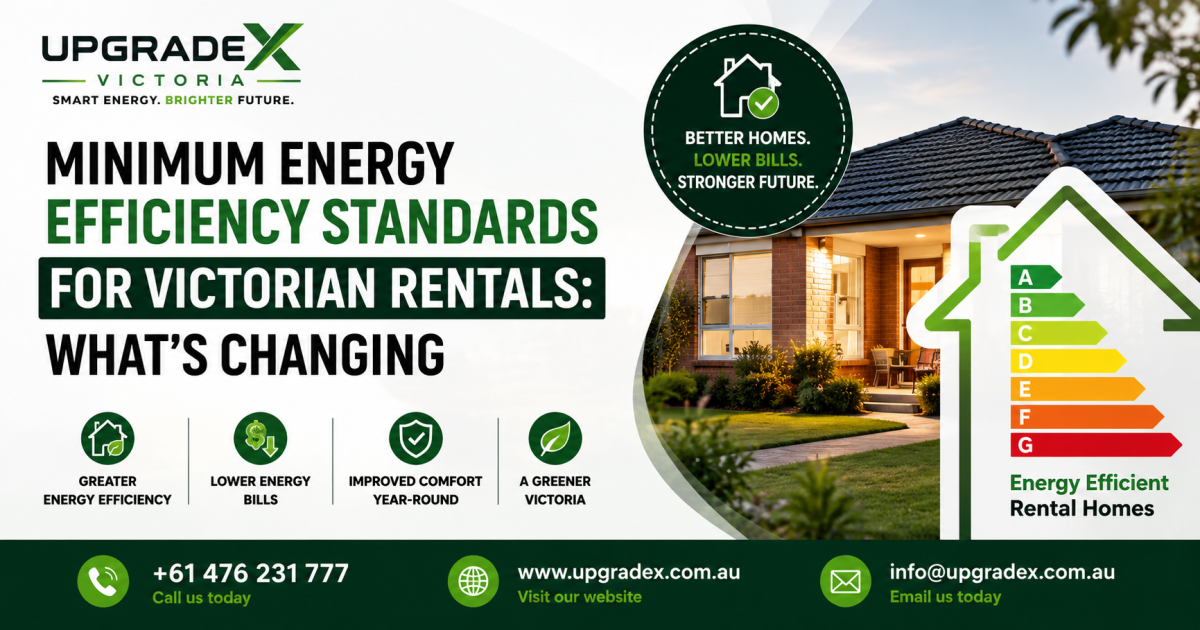
Victoria is rolling out its most significant update yet to minimum energy efficiency standards for rental properties — and if you’re a landlord or property investor, now is the time to understand what’s coming.
These changes build on the state’s existing rental minimum standards (in place since 2021) and the 2-star heating standard introduced in 2023. The new rules go further, targeting some of the biggest sources of energy waste in Victorian homes: insulation, heating, cooling, hot water, and draughtproofing.
At UpgradeX, we help Victorian landlords get ahead of these changes with rebate-supported upgrades — before compliance becomes urgent. Here’s a clear breakdown of what’s changing, when, and what it means for your property.
Why the Standards Are Changing
The Victorian Government’s reasoning is straightforward: energy-inefficient rental homes cost renters more, feel less comfortable, and generate unnecessary emissions. By lifting the baseline standard across the rental market, the government aims to:
- Make rental homes safer and more comfortable
- Help renters save on their energy bills
- Reduce household emissions statewide
- Improve long-term property values
That last point is worth pausing on. According to the Victorian Government, energy-efficient houses in Melbourne have been selling for up to $197,000 more than non-efficient equivalents, with units averaging $95,000 more. Efficiency upgrades aren’t just a compliance box to tick — they’re a genuine value driver for your property.
Key Dates You Need to Know
13 October 2026 — Record-Keeping & Safety Checks
Rental providers and agents must keep documented evidence that their property meets minimum standards, and mandatory gas and electrical safety checks must be conducted every two years.
1 March 2027 — New Standards Begin Phasing In
This is when the new energy efficiency requirements officially start applying to rental properties, covering insulation, cooling, and heating/hot water systems.
1 July 2030 — Full Compliance Deadline for Cooling
By this date, all rental properties — regardless of when the lease began — must meet the new cooling standard, unless a valid exemption applies.
What’s Actually Changing
1. Heating & Hot Water Systems
When an existing gas heater or hot water system reaches the end of its life, it must be replaced with an energy-efficient electric alternative — such as a heat pump or reverse-cycle system. This won’t apply immediately to every property, but it will apply the next time a system needs replacing.
2. Cooling Requirements
At the start of a new lease (or a conversion to a periodic/month-to-month agreement), the property must include energy-efficient cooling in the main living area — specifically:
- A minimum 3-star fixed cooling appliance, or
- A 2-star equivalent central cooling system
Where an inefficient system is already installed, it will need to be upgraded once it reaches end-of-life. Regardless of lease timing, all rental properties must meet this cooling standard by 1 July 2030.
3. Ceiling Insulation
Where a property currently has no ceiling insulation, new insulation with a minimum R-value of 5.0 must be installed.
4. Draughtproofing & Low-Flow Showerheads
The standards also target smaller, cost-effective upgrades — draughtproofing gaps around doors and windows, and installing low-flow showerheads — both of which reduce energy and water waste with minimal disruption to tenants.
Are There Exemptions?
Yes. Certain properties are exempt where compliance isn’t practical or would create unreasonable costs — for example, apartments where heating, cooling, or hot water is supplied via a centralised building system rather than individual units. A full list of exemptions is set out in Schedule 4 of the regulations, so it’s worth checking your specific property against these criteria.
What Support Is Available for Landlords?
The Victorian Energy Upgrades (VEU) Program is designed to offset the cost of these upgrades, offering rebates on eligible works such as:
- Replacing a gas heater with a reverse-cycle air conditioner
- Replacing a gas hot water system with a heat pump hot water unit
- Draughtproofing and low-flow showerhead installation
- Home energy assessments
Ceiling insulation rebates are also expected to become available in early 2027, giving landlords time to plan ahead before this requirement takes full effect.
Separately, the Solar for Rentals program offers eligible landlords a rebate of up to $1,400, covering 50% of solar panel installation costs — reducing upfront expenses while boosting both energy efficiency and property appeal.
What Landlords Should Do Now
With these changes phasing in from 2027 and full compliance required by 2030, the smartest move for landlords is to get ahead of the timeline rather than wait for a system to fail or a lease renewal to force the issue. We’d recommend:
- Get your property assessed — understand where it currently stands against the new standards
- Plan replacements strategically — if a heater or hot water system is nearing the end of its life, consider upgrading proactively rather than waiting for a breakdown
- Check your rebate eligibility — many upgrades are partially subsidised through VEU and Solar for Rentals
- Keep documentation — from October 2026, compliance record-keeping becomes mandatory
How UpgradeX Can Help
As an accredited VEU provider, UpgradeX helps Victorian landlords navigate these changes with confidence — from assessing eligibility and managing rebate paperwork, to professional installation of reverse-cycle systems, heat pump hot water units, and more.
Getting ahead of these standards now means avoiding last-minute compliance pressure later, while making your rental property more attractive to today’s energy-conscious tenants.
📞 Ready to future-proof your rental property ahead of 2027? Contact UpgradeX today for a free consultation and find out which upgrades your property may be eligible for.
This article is intended as general information and does not constitute legal advice. For full details on Victoria’s minimum energy efficiency standards, exemptions, and compliance requirements, refer to Consumer Affairs Victoria and the Victorian Government’s official guidance.