


- Your cart is empty Browse Shop
Residential Air Conditioning Noise Standards in Victoria — What Every Homeowner Needs to Know

March 30,2026
0
521
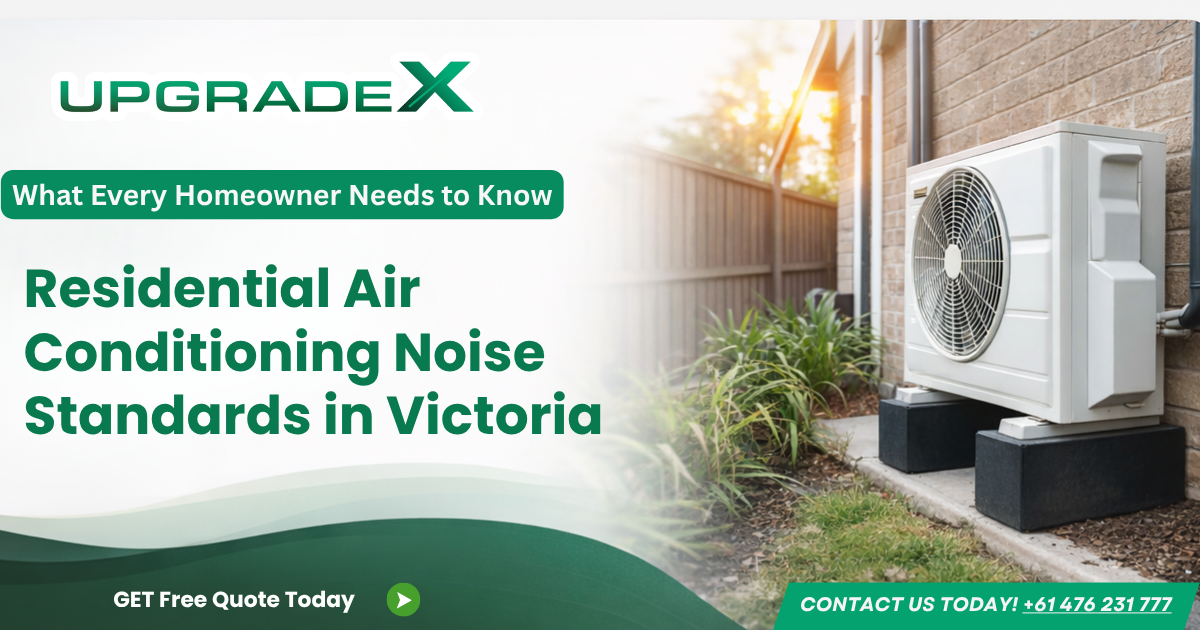
Your new air conditioner keeps your Melbourne home perfectly comfortable — but if it’s annoying your neighbours, Victoria’s noise regulations give them every right to complain. And if the complaint is upheld, your local council can direct your unit to be relocated or even switched off.
Noise from air conditioners is one of the most common neighbour disputes in Victoria. It is illegal for Victorian residents to cause unreasonable noise — and this explicitly includes noise from home air conditioners.
The good news is that with the right system, the right placement, and a licensed installer who understands Victoria’s noise requirements, noise compliance is completely straightforward. At UpgradeX, every installation we complete includes a noise assessment to ensure your system meets all relevant standards before we leave your property.
Here’s everything you need to know about residential air conditioning noise standards in Victoria in 2026.
What the Law Says — Victoria’s Noise Framework
Air conditioning noise in Victoria is regulated under two key pieces of legislation:
1. Environment Protection Act 2017 The foundation of Victoria’s environmental noise framework. The EPA Victoria has clear rules around environmental noise — air conditioner noise must not exceed the background noise level by more than 5 dB(A) when measured from a neighbour’s property.
2. Environment Protection Regulations 2021 These regulations set specific prohibited times for noisy appliances including air conditioners, and provide the enforcement framework for councils and the EPA to act on complaints.
Together, these laws create a clear standard: your air conditioning system must not create unreasonable noise for your neighbours, with specific numerical limits and restricted operating times.
The Core Noise Rule — The 5 dB(A) Standard
The fundamental noise rule for residential air conditioning in Victoria is straightforward:
Your air conditioner’s noise level must not exceed the background noise level by more than 5 dB(A) when measured at the neighbour’s property boundary.
According to Victoria’s Environment Protection Act, air conditioner noise must not exceed the background noise level by more than 5 dB when measured from a neighbour’s home. For example, if the background noise in your neighbour’s home is 40 dB, your air conditioning system should not emit more than 45 dB from their property.
What This Means in Practice
Background noise levels vary by location and time of day:
| Location Type | Typical Background Noise | Maximum Aircon Noise Allowed |
|---|---|---|
| Quiet suburban street (night) | 30–35 dB(A) | 35–40 dB(A) |
| Busy suburban street (day) | 45–50 dB(A) | 50–55 dB(A) |
| Near main road (day) | 55–60 dB(A) | 60–65 dB(A) |
| Near main road (night) | 45–50 dB(A) | 50–55 dB(A) |
The practical implication for most Melbourne homeowners: if typical ambient background noise on a day is around 35 dB, your air conditioner shouldn’t produce more than ~40 dB at the neighbour’s fence.
At night, levels should stay under 40 dB(A) in quiet residential areas. During declared heat health emergencies, these restrictions are relaxed to prioritise public safety.
Prohibited Hours — When You Can’t Run a Noisy System
Beyond the decibel limits, the Environment Protection Regulations 2021 set prohibited times for certain noisy appliances. For air conditioners, overnight use of a loud air conditioner is restricted.
The general prohibited hours for residential noise in Victoria are:
| Day | Prohibited Hours |
|---|---|
| Monday to Friday | Before 7:00 AM and after 10:00 PM |
| Saturday | Before 9:00 AM and after 10:00 PM |
| Sunday and Public Holidays | Before 10:00 AM and after 10:00 PM |
Important exception: If there’s an official heat health emergency, these time limits are relaxed so people can stay safe and cool. During Victoria’s heat health alerts, you can run your air conditioner at any hour without breaching the prohibited times — public safety takes priority.
How Noise Is Measured — Understanding Decibels
Air conditioner noise refers to the sound produced by air conditioning units during operation. It is typically measured in decibels (dB) — a unit that quantifies sound intensity on a logarithmic scale.
To put common noise levels in context:
| Sound | Approximate Level |
|---|---|
| Quiet library | 30 dB(A) |
| Normal conversation | 60 dB(A) |
| Vacuum cleaner | 70 dB(A) |
| Modern split system (outdoor unit) | 45–55 dB(A) |
| Quiet split system (bedroom unit) | 19–32 dB(A) indoor |
| Older/larger outdoor unit | 55–65 dB(A) |
An air conditioner producing noise above 70 dB is generally considered excessively loud for residential use. Modern inverter split systems from quality brands like those installed by UpgradeX typically operate well within Victoria’s noise limits.
The Most Common Sources of Aircon Noise
Understanding where noise comes from helps you choose the right system and placement:
Air conditioning noise originates from various components of the system. Fan noise is caused by the movement of air through the system’s fans. Compressor noise is generated by the compressor as it pressurises the refrigerant. Refrigerant flow noise is created as the refrigerant moves through the system’s pipes.
Common noise types and what they mean:
| Noise Type | Common Cause | Action Required |
|---|---|---|
| Whining or humming | Normal compressor operation | Usually fine — check dB level |
| Rattling or clicking | Loose components | Service required |
| Hissing or bubbling | Refrigerant flow or leak | Service required urgently |
| Loud vibration | Poor mounting or worn parts | Service required |
| Increased overall noise | System ageing or dirty filters | Service + clean filters |
If your system has suddenly become louder than usual, this is a sign it needs servicing — and it’s also likely breaching noise standards if the change is significant.
Placement — The Most Important Noise Decision
The single most effective way to ensure noise compliance is correct placement of the outdoor unit during installation. To avoid noise issues, it is important to carefully select and locate your air conditioner, as well as maintain it over its life.
Key placement principles UpgradeX follows on every installation:
Distance from boundaries: The further the outdoor unit is from the property boundary, the lower the noise level at the boundary. Every metre of additional distance reduces noise by approximately 6 dB(A).
Avoid direct line to neighbour’s windows: Sound travels in straight lines. An outdoor unit placed directly facing a neighbour’s bedroom window will transmit noise far more effectively than one facing away.
Avoid enclosed spaces: Placing an outdoor unit in an enclosed courtyard, narrow side passage, or between two walls can cause sound to amplify through reflection — even a quiet unit can exceed limits in the wrong location.
Height considerations: Ground-mounted units generally project noise horizontally. Raised or roof-mounted units may project noise over boundaries differently. Our installers assess each situation individually.
Acoustic barriers: In some Melbourne properties — particularly inner-city terraces and narrow allotments — a purpose-built acoustic barrier or noise-reducing installation solution may be required. UpgradeX can advise on this at your free assessment.
What Happens If Your Neighbour Complains?
If your local council receives a complaint and your air conditioner is causing unreasonable noise, they can direct it to be relocated or even switched off.
The typical complaint process in Victoria works as follows:
Step 1 — Neighbour-to-neighbour discussion Speak to your neighbour first — they may be unaware. If the issue continues beyond regulated hours, local councils can intervene and enforce penalties if required.
Step 2 — Council complaint If direct discussion doesn’t resolve the issue, the affected neighbour can lodge a formal complaint with your local council. The council will investigate and may conduct a noise assessment.
Step 3 — EPA involvement For serious or ongoing breaches, residents can lodge complaints with the Environment Protection Authority (EPA) if they believe an air conditioner is producing excessive noise.
Step 4 — Enforcement If the noise is found to breach regulations, the council or EPA can issue a formal notice requiring the issue to be rectified. Non-compliance can result in fines.
Step 5 — Relocation or shutdown As a last resort, the council can direct the unit to be relocated or permanently switched off.
The cost of relocating an outdoor unit after installation can be significant. Getting placement right from the start — with a licensed installer who conducts a proper noise assessment — is far cheaper than rectifying a complaint later.
What About My Neighbour’s Noisy Aircon?
If it’s your neighbour’s air conditioner causing the problem, here’s your recommended approach:
Step 1 — Speak to your neighbour calmly and politely. They may not realise it’s bothering you. They could service the unit or adjust its timing.
Step 2 — Keep a record of when the noise occurs, how long it lasts, and how loud it seems. This documentation is valuable if you need to escalate.
Step 3 — If the noise occurs during prohibited hours or seems to exceed the 5 dB(A) standard, contact your local council with your documented evidence.
Step 4 — For serious ongoing issues, contact the EPA Victoria directly.
How UpgradeX Ensures Noise Compliance on Every Installation
Every UpgradeX air conditioning installation includes a noise compliance assessment as standard — not an optional extra. Here’s our process:
Site assessment: Before recommending placement, our technicians assess your property layout, proximity to neighbours’ windows and boundaries, and any acoustic features that could affect noise transmission.
Brand selection: We only install quality VEU-approved brands whose outdoor units meet or exceed Victoria’s noise standards. Modern inverter systems from brands like Rinnai, Midea, and Daikin are significantly quieter than older technology.
Correct installation technique: Proper vibration isolation mounts, secure brackets, and correctly sized refrigerant lines all reduce operational noise. Poor installation technique is a major cause of noise complaints — and UpgradeX’s licensed technicians are trained to avoid these issues.
Post-installation check: We test your system before leaving your property and can advise if any additional noise mitigation is recommended.
Compliance certificates: UpgradeX provides both the Plumbing Compliance Certificate (VBA) and Certificate of Electrical Safety (CoES) with every installation — documentation that confirms your system was installed to required standards.
Quietest Air Conditioning Systems for Melbourne Homes
If noise compliance is a particular concern for your property — perhaps you have close neighbours, a narrow block, or noise-sensitive family members — these system types offer the best noise performance:
| System Type | Indoor Noise | Outdoor Noise | Best For |
|---|---|---|---|
| Mitsubishi Electric split system | From 19 dB(A) | 46–52 dB(A) | Bedrooms, noise-sensitive homes |
| Daikin inverter split system | From 21 dB(A) | 48–54 dB(A) | Living areas, whole-home comfort |
| Rinnai inverter split system | From 22 dB(A) | 47–53 dB(A) | Balanced performance and price |
| Midea multi-split system | From 24 dB(A) | 50–56 dB(A) | Multi-room value installations |
All of these systems, when correctly installed by UpgradeX, operate well within Victoria’s residential noise standards under normal conditions.
Frequently Asked Questions Air Conditioning Noise Standards
What is the maximum noise level for an air conditioner in Victoria? Your air conditioner must not exceed the background noise level by more than 5 dB(A) at your neighbour’s property boundary. At night in quiet residential areas, this typically means staying under 40 dB(A). During declared heat health emergencies, these limits are relaxed.
Can my neighbour force me to turn off my air conditioner? Not directly — but if your local council investigates a noise complaint and finds your system breaches regulations, the council can direct you to relocate the unit or restrict its operating hours. In serious cases the unit can be directed to be switched off.
What are the prohibited hours for air conditioning in Victoria? Air conditioners that can be heard by neighbours must not operate before 7 AM or after 10 PM on weekdays, before 9 AM on Saturdays, or before 10 AM on Sundays and public holidays. These restrictions are relaxed during official heat health emergencies.
Does UpgradeX assess noise compliance before installation? Yes — every UpgradeX installation includes a site noise assessment. We assess placement options, recommend the quietest suitable position, and only install systems that meet Victoria’s noise standards.
How can I reduce noise from my existing air conditioner? Regular servicing keeps all moving parts operating smoothly and quietly. Cleaning or replacing filters reduces strain on the fan motor. Checking that mounting brackets and vibration isolation pads are secure prevents rattling. If noise persists, contact UpgradeX for a service assessment.
Get a Fully Compliant, Quiet Installation from UpgradeX
UpgradeX is Melbourne’s trusted VEU-accredited air conditioning installer. We handle noise compliance as part of every installation — meaning you never have to worry about neighbour disputes, council complaints, or EPA enforcement.
👉 Get a Free Quote from UpgradeX — Response within 24 hours.
📞 +61 476 231 777 📧 info@upgradex.com.au
📍 54 Haystack Drive, Truganina VIC 3029
📍 Serving Nearby Subhubs Of Melbourne and all of Victoria
Last updated: March 2026. Noise regulations are subject to change. Contact UpgradeX or the EPA Victoria for the most current requirements applicable to your property.