


- Your cart is empty Browse Shop
Why You Should Replace Your Old Solar Hot Water System with a Heat Pump in Victoria

March 18,2026
0
257
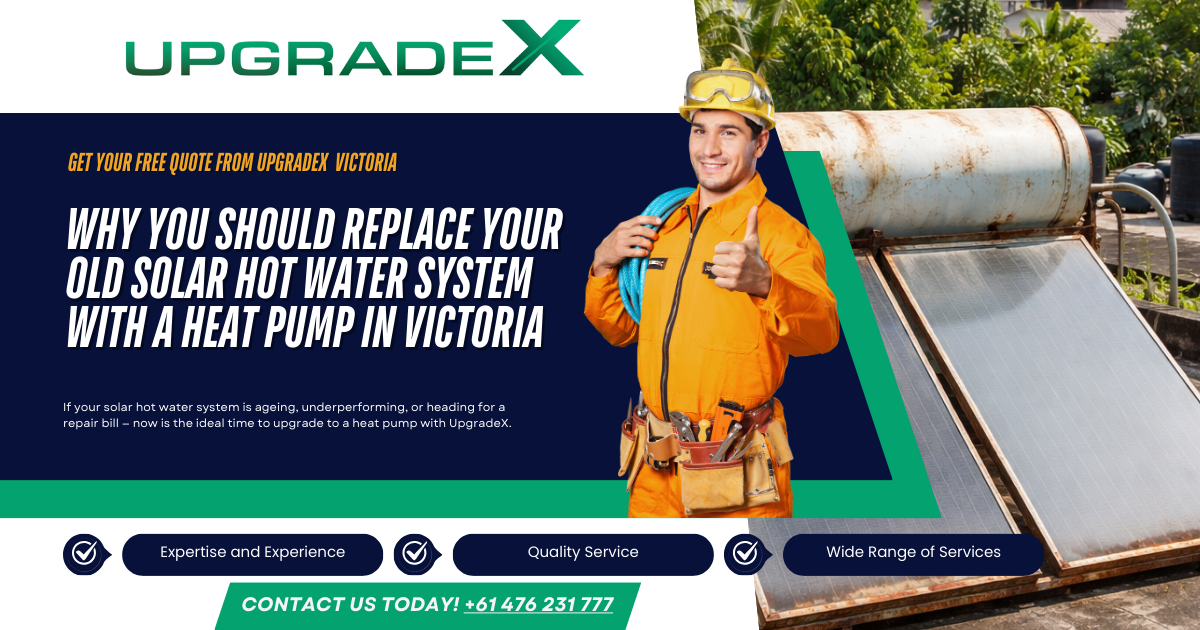
You had the right idea when you installed that solar hot water system. Back then, it was one of the smartest energy upgrades a Victorian homeowner could make.
But solar hot water systems don’t last forever — and the technology has moved on significantly. If your solar HWS is more than 10 years old, chances are it’s quietly costing you more than you realise: an ageing collector, an electric booster running overtime through winter, repair bills starting to stack up, and a system that simply can’t keep pace with modern alternatives.
In 2026, the smarter upgrade is a heat pump hot water system — and Victorian Government rebates of up to $3,000+ make the switch more affordable than ever.
In this guide we’ll explain exactly why Melbourne homeowners with old solar hot water systems are making the switch, what you can expect to save, and how UpgradeX handles the entire process from rebate to installation.
The Problem with Old Solar Hot Water Systems
Solar hot water was groundbreaking technology when it was first widely adopted in Australian homes throughout the 1990s and 2000s. But like all technology, it ages — and an old solar HWS comes with a unique set of problems that many homeowners don’t fully appreciate until things start going wrong.
1. The Collector Deteriorates Over Time
The roof-mounted solar collector panel is the heart of your system — and it takes a beating year after year from Melbourne’s weather. UV exposure, hailstorms, thermal expansion and contraction all degrade the collector over time. Older flat-plate collectors lose efficiency gradually, often without any obvious sign. You’re still getting some solar-heated water, but far less than the system was designed to deliver.
Evacuated tube collectors are more durable but still subject to tube cracking, seal failure, and manifold leaks over a 10–15 year lifespan. By the time most solar HWS units hit the 12–15 year mark, collector efficiency has dropped significantly.
2. The Electric Booster Does Most of the Work
Here’s the uncomfortable truth about older solar hot water systems in Melbourne: during autumn, winter, and overcast periods — which represent a large portion of Victoria’s year — the solar collector simply can’t heat enough water. The electric or gas booster steps in to make up the difference.
In a well-functioning, newer system this is manageable. But in an older system with a degraded collector, the booster ends up running far more than it should — sometimes doing 60–70% of the heating work through the cooler months. You’re effectively paying to run an electric resistance heater for half the year, which is one of the least efficient ways to heat water.
3. Repair Costs Start to Escalate
Once a solar HWS passes the 10-year mark, components start to fail more frequently. Common repair issues include:
- Collector leaks and tube replacements
- Pump and controller failures (in pumped systems)
- Sacrificial anode replacement (often skipped by homeowners)
- Tank corrosion and leaks
- Booster element failures
Each repair might seem manageable on its own — but the cumulative cost of keeping an ageing solar HWS running quickly adds up to thousands of dollars over a few years. At that point, you’re spending money to maintain an inefficient system rather than investing in a better one.
4. The Tank Is on Borrowed Time
Solar hot water storage tanks are typically warranted for 5–10 years. Beyond that, corrosion becomes an increasing risk — particularly if the sacrificial anode hasn’t been replaced regularly. A leaking hot water tank is not only inconvenient but can cause significant property damage. Most insurance policies don’t cover gradual leak damage, meaning a failed tank can become a very costly problem very quickly.
Why a Heat Pump Is the Better Upgrade in 2026
A modern heat pump hot water system addresses every weakness of an old solar HWS — while delivering better year-round performance, lower running costs, and a cleaner installation footprint.
How a Heat Pump Works
A heat pump extracts heat from the surrounding air and uses it to heat water stored in a well-insulated tank. It works on the same principle as a reverse-cycle air conditioner — but instead of heating or cooling your room, it heats your water.
The key advantage is efficiency. For every unit of electricity a heat pump consumes, it produces 3 to 5 units of heat energy. This is called the Coefficient of Performance (COP), and it’s what makes heat pumps so dramatically cheaper to run than electric resistance boosters or gas systems.
Critically, a heat pump works in all weather conditions — cloudy days, cold Melbourne winters, rain — because it draws heat from ambient air rather than direct sunlight. There are no collectors to degrade, no pump controllers to fail, and no roof penetrations to worry about.
Year-Round Performance Comparison
| Condition | Old Solar HWS | Heat Pump |
|---|---|---|
| Sunny summer day | ✅ Excellent | ✅ Excellent |
| Overcast Melbourne day | ⚠️ Booster required | ✅ Full performance |
| Cold winter morning | ❌ Heavy booster reliance | ✅ Operates to -10°C |
| After storm / hail | ❌ Risk of collector damage | ✅ No roof components |
| 15-year performance | ❌ Significantly degraded | ✅ Consistent efficiency |
Running Costs: Old Solar HWS vs Heat Pump
This is where the comparison gets very clear for Melbourne homeowners. While a well-functioning new solar HWS can be extremely economical, an older unit with a degraded collector and overworked booster often costs significantly more to run than homeowners realise.
Annual Running Cost Comparison — 4-Person Melbourne Household
| System | Annual Running Cost | Notes |
|---|---|---|
| New solar HWS (functioning well) | $150–$250/year | Best case — clear climate, new system |
| Old solar HWS (10+ years, degraded) | $450–$750/year | Booster running 50–70% of heating load |
| Heat pump (standard tariff) | $300–$500/year | Consistent year-round |
| Heat pump (off-peak tariff) | $200–$350/year | Scheduled overnight heating |
| Heat pump + existing solar PV | $50–$150/year | Solar powers the heat pump during the day |
The most important row in that table is the last one. If you already have solar panels on your roof — which many Victorian homeowners who previously installed solar HWS now do — a heat pump powered by your solar PV system is extraordinarily cheap to run. By scheduling your heat pump to run during daylight hours when your solar panels are generating, you can reduce your hot water running cost to as low as $50–$150 per year.
This is something an old rooftop solar hot water system simply cannot compete with as it ages and its collector degrades.
What About the Roof Collector — Do I Need to Remove It?
This is one of the most common questions we receive from homeowners upgrading from solar HWS. The answer depends on your situation:
If the collector is in good condition: In some cases, a heat pump can be installed to work alongside an existing solar collector, using solar-heated water as a pre-heat source. This can further reduce running costs. However, this option requires assessment by a licensed installer to confirm compatibility.
If the collector is degraded or damaged: The collector will be removed as part of the upgrade. UpgradeX handles full decommissioning of your old solar HWS, including collector removal, roof patching, and responsible disposal.
The roof penetrations: When a solar collector is removed, the roof penetrations (pipes and brackets) need to be properly sealed. Our licensed plumbers handle this as part of the installation process, ensuring your roof is weathertight after the upgrade.
The storage tank: Your existing solar hot water storage tank is also removed and recycled. A new heat pump unit (with integrated tank) is installed in its place, typically in the same location or nearby outdoors.
Victorian Government Rebates for Replacing Solar HWS
Here’s where things get particularly interesting. Many homeowners assume that because they already have a solar hot water system, they won’t qualify for Victorian Government rebates on an upgrade. This is not necessarily true.
1. Solar Victoria Hot Water Rebate
The Solar Victoria hot water rebate can help you cover the cost of installing an efficient heat pump or solar hot water system, and is calculated as 50% of the purchase price of the product after any other discounts have been applied.
The hot water rebate provides Victorian households with up to $1,400 to assist with the purchase of an eligible heat pump or solar hot water system. The higher $1,400 amount applies when you choose an Australian-made heat pump unit.
Eligibility requirements for Solar Victoria rebate:
- Owner-occupier of the property
- Household income under $210,000/year before tax
- Property valued under $3 million
- Have not previously received a Solar Victoria hot water rebate
- Use a Solar Victoria authorised retailer (UpgradeX is authorised)
2. VEU Program Discount
The Victorian Energy Upgrades (VEU) program provides an upfront discount on the cost of an approved heat pump hot water system, based on the energy savings your new system is expected to deliver over its lifetime.
Important note for solar HWS replacement: The VEU program’s hot water activity is specifically designed for replacing inefficient electric or gas hot water systems. If your solar HWS uses an electric booster — which most do — and that booster is doing a significant portion of the heating work, the system may qualify as an inefficient electric system for VEU purposes. UpgradeX will assess your eligibility at your free quote.
3. Federal STCs (Small-scale Technology Certificates)
The federal government’s Renewable Energy Target scheme provides an upfront discount through Small-scale Technology Certificates (STCs) for approved heat pump installations. This typically delivers $300–$600 off your installation cost depending on the model and location.
Combined Rebate Summary
| Rebate | Amount |
|---|---|
| Solar Victoria Hot Water Rebate | Up to $1,000–$1,400 |
| VEU Program Discount (if eligible) | $500–$1,000+ |
| Federal STCs | $300–$600 |
| Total potential saving | Up to $3,000+ |
If your hot water system needs emergency replacement, you do not have to wait for eligibility confirmation before installing — but you must prove eligibility as soon as possible after installation to receive the rebate.
Is Your Old Solar HWS Eligible for Replacement Rebates?
Use this quick checklist to understand your likely eligibility:
Solar Victoria rebate — you likely qualify if:
- ✅ You own and live in the property
- ✅ Household income under $210,000/year
- ✅ Property value under $3 million
- ✅ You have not received this rebate before
- ✅ You use a Solar Victoria authorised installer (UpgradeX)
VEU rebate — you may qualify if:
- ✅ Your property is located in Victoria
- ✅ The property was built more than 2 years ago
- ✅ Your solar HWS uses an electric booster as its backup heating source
- ✅ The system is being replaced (not supplemented) with an approved heat pump
Not sure? UpgradeX will assess your full rebate eligibility at no charge as part of your free quote. We handle all rebate paperwork — you just pay the reduced amount on installation day.
Real Savings Example: Melbourne Homeowner Replacing Old Solar HWS
Here’s a realistic example of what the upgrade looks like for a typical Melbourne household:
Situation:
- 4-person family in Melbourne’s south-east
- 14-year-old solar hot water system (flat plate collector, electric booster)
- Collector clearly degraded — booster running constantly in winter
- 6.6kW solar PV system installed 3 years ago
Old system running cost: ~$620/year (electric booster doing most of the work)
Option: Replace with heat pump via UpgradeX
| Cost Item | Amount |
|---|---|
| Heat pump supply + install (before rebates) | $3,800 |
| Solar Victoria rebate | -$1,000 |
| Federal STCs | -$450 |
| VEU discount (if eligible) | -$600 |
| Net cost to homeowner | ~$1,750 |
New running cost (heat pump powered by solar PV during day): ~$120/year
Annual saving: $500/year
Payback period: ~3.5 years
10-year saving: ~$3,250 (running costs alone, not including avoided repair costs on old system)
The UpgradeX Installation Process
Replacing your solar hot water system with a heat pump through UpgradeX is a smooth, fully managed process:
Step 1 — Free Assessment & Quote We visit your home, assess your existing solar HWS, confirm rebate eligibility, and recommend the right heat pump size for your household. No obligation, response within 24 hours.
Step 2 — Rebate Application For the Solar Victoria rebate, we apply for your eligibility letter before installation. UpgradeX manages this entire process — you don’t need to do anything.
Step 3 — Installation Day Our licensed team removes your old solar collector (including roof decommissioning), removes the old storage tank, and installs your new heat pump unit. Most jobs are completed within a single day.
Step 4 — Compliance Certificates We provide your Plumbing Compliance Certificate (VBA) and Certificate of Electrical Safety (CoES) — required documentation that guarantees the installation meets all Victorian regulations.
Step 5 — Rebate Processing All rebate paperwork is submitted by UpgradeX. The rebate value has already been deducted from your invoice — there’s nothing more for you to do.
Step 6 — Start Saving Your new heat pump is ready to go, delivering consistent hot water year-round at a fraction of your old running costs.
Frequently Asked Questions
Can I keep my solar panels and just replace the hot water system? Absolutely — your rooftop solar PV panels are completely separate from your solar hot water system. Replacing the solar HWS has no impact on your solar PV setup. In fact, pairing a heat pump with your existing solar PV panels is one of the most efficient combinations possible.
My solar hot water system is still working — should I wait until it breaks? We recommend not waiting. If your system is over 10 years old and you’re already seeing higher energy bills or repair costs, the savings from upgrading now outweigh the cost of running the old system to failure. Additionally, rebate programs have limited availability — there’s no guarantee current rebate amounts will still be available in 12–24 months.
How long does a heat pump hot water system last? Quality heat pump systems have a lifespan of 13–15 years, often longer with proper maintenance. This is comparable to or better than the typical lifespan of a solar hot water system.
Will the heat pump work in Melbourne’s cold winters? Yes. Modern heat pumps are rated to operate effectively in ambient temperatures as low as -10°C — well below anything Melbourne typically experiences. Winter performance is consistent, unlike older solar HWS units that rely on the sun.
Where is the heat pump installed? Heat pump units are installed outdoors — typically where your old solar storage tank was located, or in another outdoor area with good airflow. The unit requires adequate ventilation to draw in ambient air efficiently. Our team will advise on the best placement for your property.
What happens to my old solar collector on the roof? UpgradeX removes the collector, associated pipework, and brackets as part of the installation. Roof penetrations are properly sealed and weatherproofed by our licensed plumbers. The old equipment is responsibly disposed of and recycled.
Do I need to upgrade my switchboard? Most standard Victorian homes will not need a switchboard upgrade for a heat pump installation. Our licensed electrician will assess your switchboard at the time of the quote and advise if any additional work is required.
Ready to Upgrade Your Solar Hot Water System?
If your solar hot water system is ageing, underperforming, or heading for a repair bill — now is the ideal time to upgrade to a heat pump with UpgradeX.
We’re a Melbourne-based, Solar Victoria authorised retailer. We manage your entire upgrade from rebate application to completed installation — and we deduct all rebates from your invoice upfront so you never have to wait for reimbursement.
👉 Get Your Free Quote from UpgradeX — We’ll assess your system, confirm your rebate eligibility, and provide a transparent quote within 24 hours.
📞 Call us anytime: +61 476 231 777
📧 Email: info@upgradex.com.au
📍 Serving Melbourne and all of Victoria
Last updated: March 2026. Rebate amounts are subject to change based on VEEC market prices and program availability at time of installation. Contact UpgradeX for current rebate estimates specific to your property and existing system.