

- Your cart is empty Browse Shop
Daikin vs Mitsubishi Air Conditioners: Which Is Better for Melbourne Homes?

March 27,2026
0
696
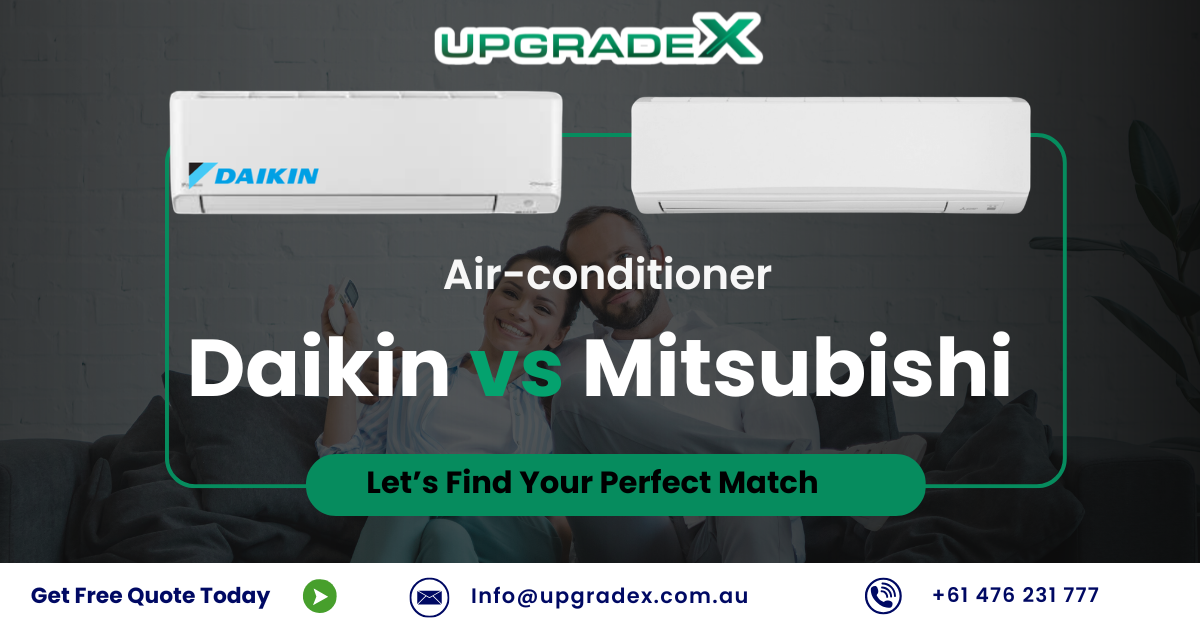
When Melbourne homeowners ask us which brand to choose, two names come up more than any other: Daikin vs Mitsubishi Air Conditioners
Both are Japanese-engineered. Both are trusted names in Australian homes. Both are VEU rebate eligible. And both will keep your Melbourne home comfortable through our famous four-seasons-in-one-day weather.
But they are not identical — and the differences matter depending on what you value most: whisper-quiet operation, whole-home ducted performance, advanced smart features, or simply the best value for your dollar.
In this guide, UpgradeX breaks down the real differences between Daikin and Mitsubishi Electric for Melbourne homeowners in 2026 — so you can make the right choice for your home, your budget, and your lifestyle.
Quick Verdict Daikin vs Mitsubishi Air Conditioners
| Daikin | Mitsubishi Electric | |
|---|---|---|
| Best for | Ducted systems, whole-home cooling, humidity control | Bedroom splits, quiet operation, smart sensing |
| Price | Higher upfront | More affordable |
| Cooling efficiency | Excellent | Excellent |
| Heating efficiency | Excellent | Slightly edges ahead |
| Noise | Ultra-quiet | Extremely quiet |
| Smart features | Daikin app + Streamer tech | i-See Sensor + MELCloud |
| Warranty | 5 years | 5–7 years |
| VEU eligible | Yes | Yes |
| Best overall | Ducted & large spaces | Split systems & bedrooms |
About Daikin
Unlike Mitsubishi Electric, Daikin specialises solely in air conditioning products — it’s all they do, and they’ve been doing it for nearly a century. This laser focus means every dollar of Daikin’s R&D goes into perfecting heating and cooling technology. The result is a product range that consistently sets the benchmark for whole-home performance.
Daikin is praised for its dedicated HVAC expertise, reliable performance, and smart connectivity. Their FDYAN Series ducted systems are among the most popular choices for Victorian households, and their split system range covers everything from ultra-compact bedroom units to large living area systems.
Daikin’s key strengths:
- Dedicated HVAC specialist — 100% focus on air conditioning
- Industry-leading inverter technology for energy efficiency
- Some Daikin models boast a 7-star energy rating, making them among the best in the market for efficiency
- Streamer Discharge technology removes airborne allergens and bacteria
- Intelligent Eye sensor detects human presence and adjusts operation
- Econo Mode limits power consumption to prevent circuit breaker trips
- Strong whole-home ducted system performance
About Mitsubishi Electric
It’s worth noting upfront that Mitsubishi Electric and Mitsubishi Heavy Industries are two separate companies. Despite their similar names, Mitsubishi Electric and Mitsubishi Heavy Industries are separate companies that produce air conditioners. Mitsubishi Electric is known for its advanced technology, quiet operation, and user-friendly interfaces.
Mitsubishi Electric has been producing air conditioners since 1954 — over 70 years of innovation specifically for Australian conditions. Mitsubishi Electric focuses more on room-by-room comfort with steady cooling and strong build quality. Many homeowners choose it for bedrooms and living areas where comfort needs to feel consistent and calm.
Mitsubishi Electric’s key strengths:
- Mitsubishi is famous for being extremely quiet. Some small units are almost silent, which is great for bedrooms or study rooms.
- i-See Sensor detects room occupancy and temperature variations for improved efficiency
- I-Save Mode remembers preferred temperature settings — reduces power consumption
- MELCloud app for smart home integration and remote control
- Hyper-Heating technology for effective performance in colder conditions
- Night Mode for ultra-low noise during sleeping hours
Head-to-Head Comparison Daikin vs Mitsubishi Air Conditioners
1. Energy Efficiency — Essentially Tied
Both brands excel at energy efficiency and exceed Australia’s Minimum Energy Performance Standards (MEPS). Daikin systems often rank slightly higher in energy efficiency for cooling, while Mitsubishi Electric systems are known to edge ahead in heating efficiency.
For Melbourne’s climate — where heating is used heavily through our cooler months — this is worth noting. If heating performance is your priority, Mitsubishi Electric’s edge in this area is relevant.
For cooling performance and humidity control in Melbourne’s humid summer days, Daikin is praised for its comfort and humidity control — a genuine advantage in Melbourne summers when high humidity can make a home feel stuffy even when the temperature is moderate.
Verdict: Both brands are excellent. Daikin slightly edges ahead for cooling and humidity. Mitsubishi Electric slightly edges ahead for heating. For Melbourne’s climate where both matter, this is essentially a draw.
2. Noise Levels — Mitsubishi Electric Wins
This is where Mitsubishi Electric has a genuine advantage — particularly for bedroom installations.
Mitsubishi is famous for being extremely quiet. Some small units are almost silent, which is great for bedrooms or study rooms. Daikin is also quiet indoors. However, larger outdoor units, especially for big ducted systems, can be a little louder compared to Mitsubishi.
Both brands offer quiet indoor units, but Mitsubishi Electric’s reputation for whisper-quiet operation — particularly their Night Mode feature — makes them the preferred choice for light sleepers and noise-sensitive environments.
Verdict: Mitsubishi Electric wins on noise, especially for bedrooms and home offices. Daikin is still very quiet but Mitsubishi’s edge here is real.
3. Smart Features — Different Approaches, Both Excellent
Both brands offer Wi-Fi connectivity and smart home integration, but their approaches differ:
| Feature | Daikin | Mitsubishi Electric |
|---|---|---|
| App control | Daikin Mobile Controller | MELCloud app |
| Presence detection | Intelligent Eye sensor | i-See Sensor |
| Air purification | Streamer Discharge technology | Standard filtration |
| Temperature memory | Econo Mode | I-Save Mode |
| Voice assistant | Compatible with Alexa/Google | Compatible with Alexa/Google |
| Self-cleaning | Yes — on select models | No — requires manual cleaning |
Daikin’s Streamer Discharge technology is a genuine differentiator for allergy sufferers and households with pets — it actively breaks down and removes airborne pollutants, viruses, odours, and mould rather than simply trapping them in a filter.
Mitsubishi Electric’s i-See Sensor, which detects where people are in the room and adjusts airflow direction automatically, provides a more personalised comfort experience that many users find superior for everyday living.
Verdict: Daikin wins on air quality with Streamer technology. Mitsubishi wins on personalised comfort with i-See Sensor. Choose based on your priority.
4. Ducted Systems — Daikin Wins
For Melbourne homeowners looking at whole-home ducted reverse cycle systems, Daikin is praised for its dedicated HVAC expertise, reliable performance and smart connectivity in the ducted category specifically.
Daikin focuses on full-home systems. It is strong in ducted systems and larger setups that cool the whole house or building evenly.
Daikin’s PMV (Predicted Mean Vote) Control technology automates whole-home temperature management by detecting outdoor conditions and adjusting accordingly — a genuinely useful feature for Melbourne’s unpredictable weather. Their two-piece fan coil unit design also makes installation easier in tight roof spaces.
Verdict: For ducted systems, Daikin is the stronger choice. For split systems in individual rooms, the choice is more even.
5. Price — Mitsubishi Electric Wins
Across the board, Mitsubishi Electric is generally the more affordable choice.
For Melbourne homeowners, here’s what to expect in 2026 after VEU rebates:
| System Type | Daikin (After VEU Rebate) | Mitsubishi Electric (After VEU Rebate) |
|---|---|---|
| Split system (2.5–3.5kW) | ~$1,200–$1,800 installed | ~$1,000–$1,500 installed |
| Multi-split system | ~$3,500–$6,000 installed | ~$3,000–$5,500 installed |
| Ducted system | ~$7,000–$12,000 installed | ~$6,000–$10,000 installed |
Prices are indicative after VEU rebates applied by UpgradeX. Exact figures vary based on system size and what’s being replaced.
Daikin models are more expensive to purchase but may be cheaper to operate over the long run because of their higher efficiency ratings. As for installation costs, both brands should cost about the same to install.
Verdict: Mitsubishi Electric wins on upfront price. Daikin may offset this through slightly lower running costs over time, particularly for ducted systems used year-round.
6. Reliability & Warranty
Daikin is generally considered the gold standard in reliability. Mitsubishi Electric is also excellent, with easily available parts and great customer support.
On warranty:
- Daikin: 5-year residential warranty (standard)
- Mitsubishi Electric: 5–7 years depending on model and registration
Both brands have strong Australian service networks with authorised technicians across Melbourne and regional Victoria.
Verdict: Both brands are highly reliable. Mitsubishi Electric offers a longer warranty on select models.
7. VEU Rebate Eligibility — Both Equal ✅
Both Daikin and Mitsubishi Electric have models on the VEU approved product register maintained by the Essential Services Commission. The rebate amount is identical for both brands — it’s based on the capacity of the system and what you’re replacing, not which brand you choose.
When replacing a gas ducted heater with either brand’s ducted reverse cycle system through UpgradeX, you can access rebates of up to $8,000 applied directly to your installation invoice.
Verdict: VEU rebate availability and amount is identical for both brands. Your choice of Daikin or Mitsubishi Electric does not affect your rebate.
Daikin vs Mitsubishi Electric — Final Scorecard
| Factor | Daikin | Mitsubishi Electric | Winner |
|---|---|---|---|
| Cooling efficiency | Excellent | Excellent | Tied ✅ |
| Heating efficiency | Excellent | Slightly better | Mitsubishi ❄️ |
| Noise levels | Very quiet | Ultra-quiet | Mitsubishi 🔇 |
| Air purification | Streamer tech ✅ | Standard | Daikin 🌬️ |
| Smart sensing | Intelligent Eye | i-See Sensor | Tied ✅ |
| Ducted systems | Excellent | Very good | Daikin 🏠 |
| Upfront price | Higher | Lower | Mitsubishi 💰 |
| Warranty | 5 years | 5–7 years | Mitsubishi 📋 |
| Reliability | Gold standard | Excellent | Tied ✅ |
| VEU eligible | Yes | Yes | Tied ✅ |
Which Brand Is Right for You? Daikin vs Mitsubishi Air Conditioners
Choose Daikin if:
- You’re installing a whole-home ducted system
- Someone in your household has allergies or asthma (Streamer technology)
- You want the most advanced inverter ducted technology
- You value Daikin’s HVAC-only expertise
- Humidity control matters to you in Melbourne summers
- You want a self-cleaning system (select models)
Choose Mitsubishi Electric if:
- You’re installing a split system for a bedroom or living area
- Quiet operation is your top priority
- You want lower upfront cost without compromising on quality
- Personalised airflow sensing appeals to you (i-See Sensor)
- You want a longer warranty on select models
- You’re fitting out multiple rooms and need value across several units
Both Available with VEU Rebates Through UpgradeX
Whether you choose Daikin or Mitsubishi Electric, UpgradeX can supply and install your system with full VEU rebates applied upfront:
| Upgrade | VEU Rebate |
|---|---|
| Gas ducted → Ducted reverse cycle (Daikin or Mitsubishi) | Up to $8,000 |
| Gas heater → Multi-split system | Up to $7,200 |
| Old split → New reverse cycle split | $200–$500 |
All rebates are applied directly to your invoice. UpgradeX handles all VEU compliance and paperwork — you simply pay the reduced price on the day.
Frequently Asked Questions Daikin vs Mitsubishi Air Conditioners
Is Daikin or Mitsubishi Electric better for Melbourne winters? Both brands perform excellently in Melbourne’s winters. Mitsubishi Electric holds a slight edge in heating efficiency, while Daikin’s whole-home ducted systems provide superior even heating across larger homes. For a bedroom split system, Mitsubishi Electric’s quieter overnight operation is a genuine advantage.
Which brand is better for ducted air conditioning in Melbourne? Daikin is generally considered the stronger choice for ducted systems due to its HVAC-only expertise, PMV Control technology, and two-piece fan coil unit design. Both brands are VEU eligible and both perform excellently in Melbourne conditions.
Do both brands qualify for VEU rebates in Victoria? Yes — both Daikin and Mitsubishi Electric have VEU-approved models. UpgradeX installs both brands and applies all available VEU rebates upfront. The rebate amount is the same regardless of which brand you choose.
What’s the main difference between Mitsubishi Electric and Mitsubishi Heavy Industries? They are separate companies despite sharing a name. Mitsubishi Electric is the better-known brand in the Australian residential market. Mitsubishi Heavy Industries produces more industrial-focused equipment. When Melbourne homeowners say “Mitsubishi aircon” they almost always mean Mitsubishi Electric.
Which brand is quieter? Mitsubishi Electric has a slight noise advantage, particularly in split systems and during overnight operation with Night Mode. Both brands are exceptionally quiet by any standard — you won’t be disturbed by either in normal operation.
Get Your Free Quote from UpgradeX
Not sure whether Daikin or Mitsubishi Electric is right for your Melbourne home? Our team will assess your home, compare both options, and recommend the best system for your specific needs — with your full VEU rebate applied upfront.
Get a Free Quote from UpgradeX — Response within 24 hours.
📞 +61 476 231 777
📧 info@upgradex.com.au
📍 Serving Melbourne and all of Victoria
Last updated: March 2026. Prices are indicative after VEU rebates and subject to change. Contact UpgradeX for a personalised quote.